24.
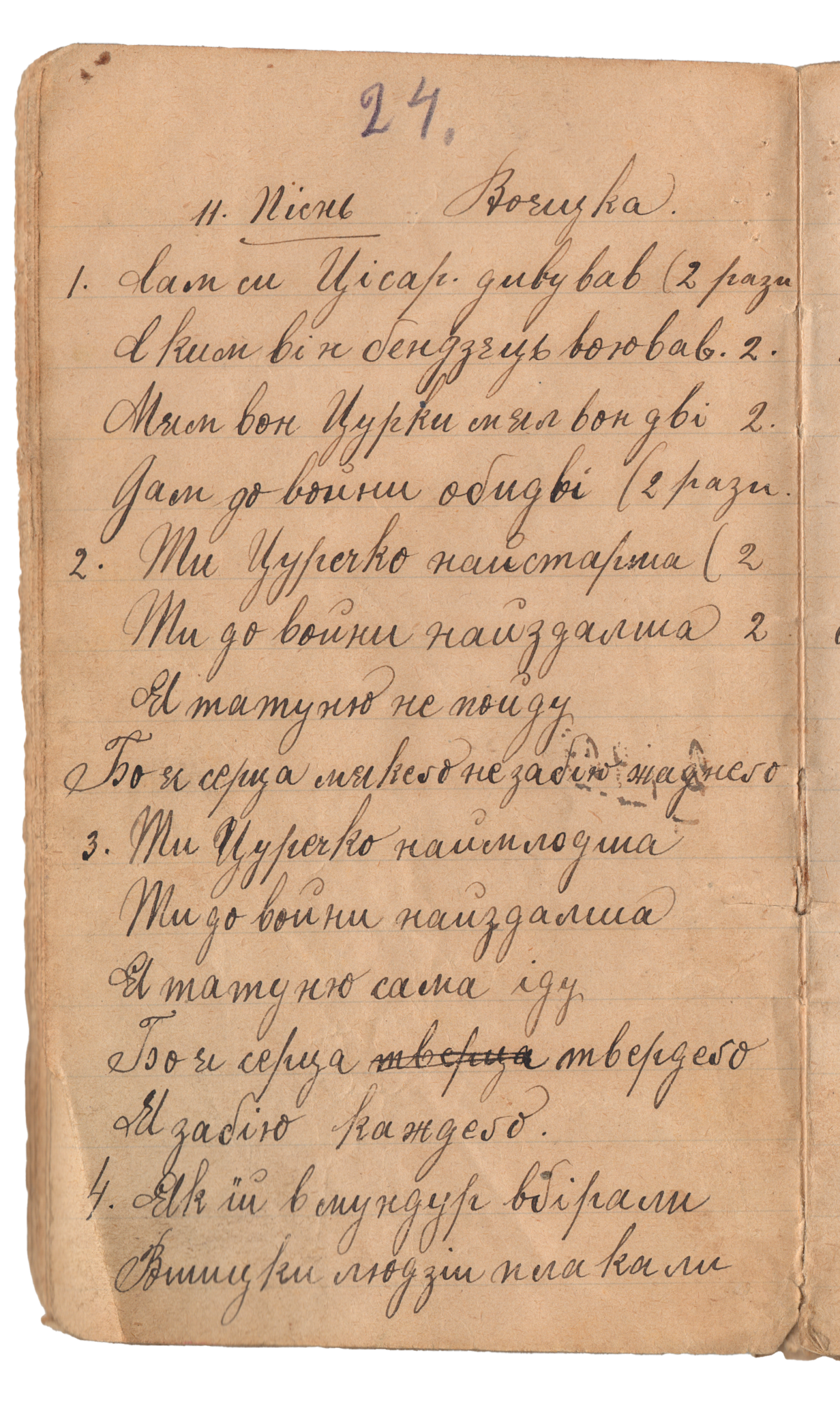
11. Піснь Вогучка.
1. Нам си Цісар дивував (2 рази
З ким він бенджуць воював. 2.
Мим вон Цурки сия вон дби 2.
Дам до воини обиди (2 рази.
2. Ми Цуперко наистарша (2
Ми до воини наиздалиа 2
А матуню не поиду
Бо и серця ми кего не дзиви жаднего
3. Ми Цуперко наимлодша
Ми до воини наиздалиа
А матуню сама иду
Бо и серця тверда твердего
А дзиво каждего.
4. Як и в мундур вбирали
Вшицки люди плакали
24.
11. Song of Voguchka.
1. The Emperor wondered at us (2 times
With whom he the judge fought. 2.
Between them the Turks they fought 2.
Gave offenses to the war (2 times.
2. We Tsuperko the oldest (2
We went to the war the most dashing 2
With mother I will not go
For my heart would not give him any
3. We Tsuperko the youngest
We went to the war the most dashing
With mother I myself go
For my heart is firm, very firm
And I killed every one.
4. And when they put on the uniform
All the people cried
The “Voguchka” song (Піснь Вогучка) on page 24 is a traditional Lemko/Carpathian Ruthenian folk recruit song from the Austro-Hungarian Empire era (late 19th–early 20th century).
It is a regional variant of the well-known Lemko/Galician song cycle often titled “Пришла карта з Сянока” (“A draft card came from Sanok”) or “Кедь ми прийшла карта” (“When the card came to me”). These songs were popular among the Lemko, Boyko, and Rusyn people in the Carpathian mountains (present-day southeastern Poland, western Ukraine, and parts of Slovakia).
These recruit songs were passed orally for generations, with many local variants. They blend humor, lament, and social commentary on military life. The version in your notebook is a rare handwritten record of one such local adaptation, preserved exactly as sung in the early 1900s.