26.
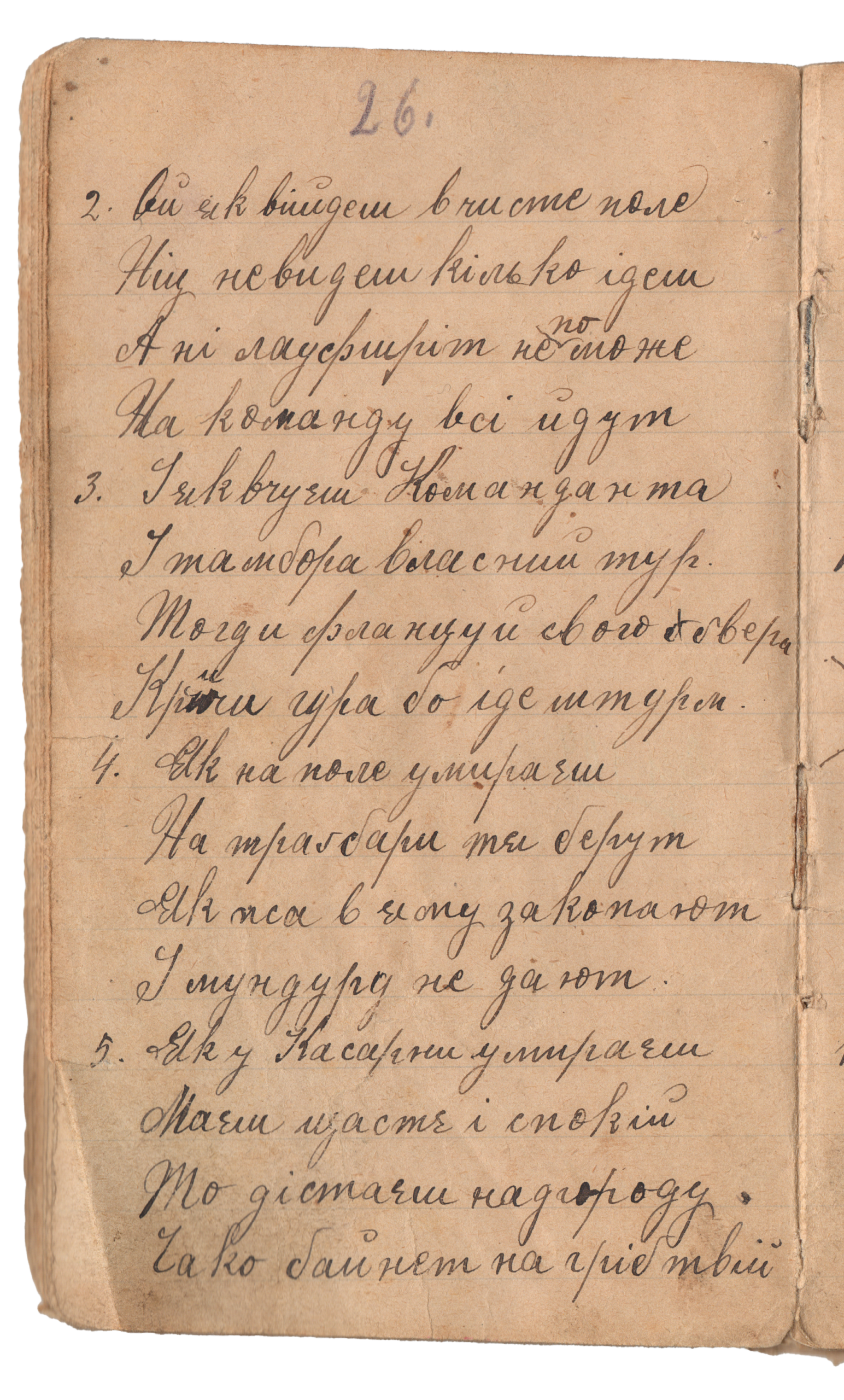
2. Віи як вийдеш в чисте поле
Ніц не видем кілько ідеш
А ні лаусриіт не може
На команду всі ідут
3. Тик вруи Команданта
І там бора власний тур.
Могди ела нуцу свого довера
Кріми ура бо іде штурм .
4. Вк на поле умираєш
На травабри ти берут
Вк тса в тому законатом
І шундуру не да ют .
5. Вк у Касарни умираєш
Маши цасте і спокій
То дістани надгороду .
За ко баінет на гнів твій
26.
2. When you go out into the open field
You see nothing no matter how far you go
And no laurel can help
Everyone goes to the command
3. Thus entrust the Commandant
And there Bora has his own tour.
The French perhaps their own governor
Except the tsar because the assault is coming.
4. In the army you die in the field
They take you on stretchers
In the army it is according to the law
And they do not give uniforms.
5. In the army in the barracks you die
You have happiness and peace
Then you receive a reward.
For whom Sainet will take your anger
This particular poem (on page 26 of the notebook) is part of a larger personal handwritten collection of Ukrainian folk songs (pisni) copied around early 1909 (the date “2/i/1909” appears repeatedly throughout the manuscript, often next to the name “Hrechukh” or similar, likely the person who transcribed or owned the notebook).
Historical context (1909, Russian Empire): At that time, most of Ukraine was under strict tsarist Russian rule. Ukrainian language and culture were heavily suppressed (following laws like the 1876 Ems Ukaz), so ordinary people preserved their heritage through private notebooks like this one—hand-copied folk songs passed down orally. Military service was mandatory for peasant men, who were often conscripted into the Russian Imperial Army for many years, frequently far from home. This created a whole genre of рекрутські пісні (recruit songs) and солдатські пісні (soldier songs) that realistically (and sometimes bitterly) described army life: endless drills, commands, assaults (shтурм), barracks (kasarny), stretchers for the wounded, and the grim reality that many soldiers died in the field or in barracks without glory.
The poem on this page is a classic example of that tradition. It paints a bleak, almost ironic picture of a soldier’s fate: no matter where you go or what you do, you end up under command, marching to the assault, dying on the battlefield or in the barracks, and receiving only a meager “reward” (perhaps a pension, funeral, or ironic “honor” for your suffering). It contrasts sharply with the love-and-Cossack-romance songs found on other pages in the same notebook, highlighting the tension between personal life and the harsh demands of imperial military service.
These songs served as both entertainment and quiet protest—voicing the hardships of ordinary Ukrainians while keeping national language and identity alive in private. The notebook itself is a wonderful surviving artifact of that underground cultural resistance on the eve of World War I and the Ukrainian national awakening that followed.