53.
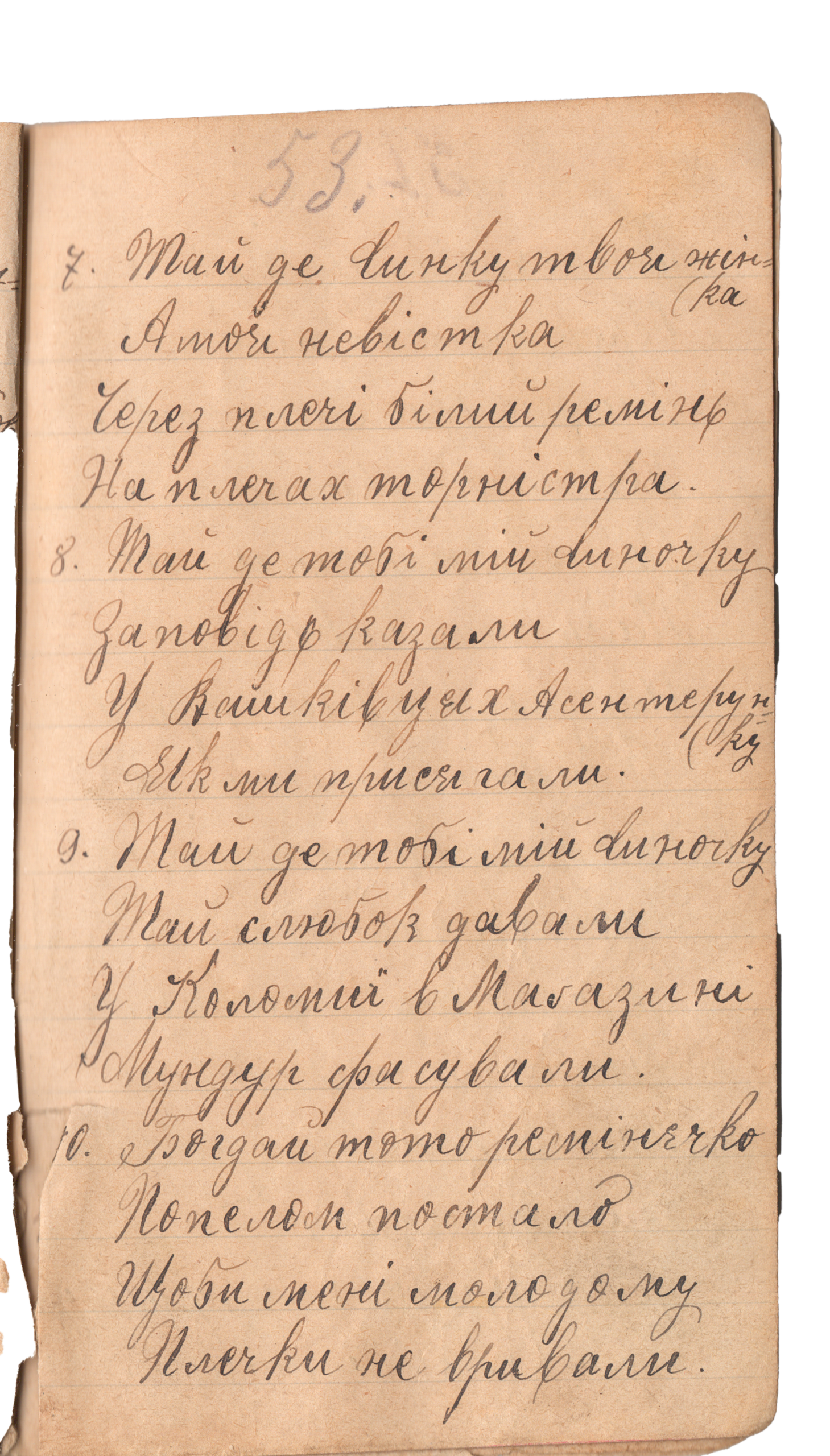
7. Май де динку твою жни
Амои невістка
Через пюрі білиі ремінь
На плечах торністра.
8. Май де тобі мій динокy
Заповір казами
У Вашківцях Асентеју
Як ми присагали.
9. Май де тобі мій динокy
Май слобоз давами
У Коломий в Магазині
Мундир срасува ли.
10. Тогдай тото ремінерко
Попелом постало
Щоби мені молодому
Плеки не вривали.
53.
7. May the daughter of yours be taken
Oh my daughter-in-law
Through the white straps of the belt
On the shoulders the knapsack.
8. May to you my son-in-law
The regiment orders
In Vashkivtsi to the sergeant
As we swore.
9. May to you my son-in-law
May the freedom be given
In Kolomyia in the store
The uniform was tried on.
10. Then that strap
Became covered with ash
So that to me the young one
The straps would not tear.
Core of page 53:
This is the continuation (stanzas 7–10) of the same folk song that began on page 52. The mother (or the family voice) now directly addresses her son-in-law (“mій динокy” = my son-in-law) who has already joined the army. She describes the moment he is outfitted as a soldier: the white straps of the belt, the knapsack (“торністра”) on his shoulders, the regiment’s orders in Vashkivtsi at the sergeant’s (“Асентеју”), the oath they swore, the uniform being tried on in the Kolomyia store, and the strap itself becoming covered in ash from heavy use. The final lines carry a mix of bitter sarcasm and maternal concern — wishing the straps would not tear on her young son-in-law so he can endure military life.
Main theme: The inescapable burden of military service and its impact on the family.
While page 52 was the mother’s firm refusal to give her daughter to a soldier, page 53 flips the perspective: the son-in-law has been taken by the army. The song now laments (or ironically comments on) the reality of conscription — the uniforming, the oath, the gear that physically and symbolically weighs the young man down. The repeated “Май де…” (“May…”) constructions give it the tone of a resigned blessing or a mother’s worried prayer mixed with dark humor about the “freedom” the army supposedly grants. It is a classic Ukrainian folk motif: the pain of separation caused by war/conscription, the transformation of a village boy into a soldier, and the family’s powerless acceptance once the uniform is on.