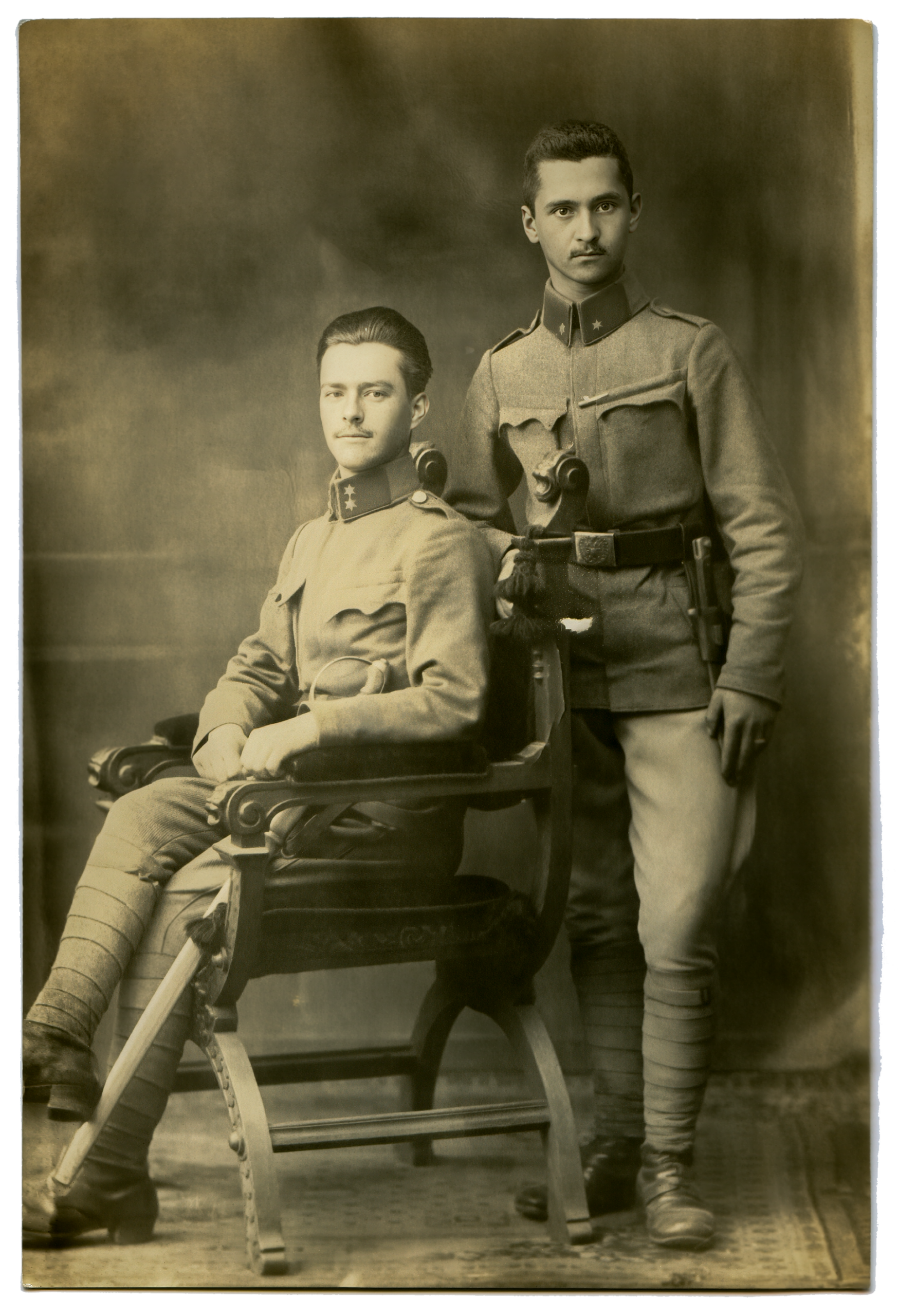
The attached photo is a classic early 20th-century studio portrait (sepia-toned, professionally posed. It shows two young men (likely brothers, close relatives, or comrades, given their similar ages, facial features, dark neatly combed hair, and thin mustaches) in military uniforms from the World War I era (circa 1914–1918).
What is seen in the image (detailed visual description):
Seated man (left): Positioned in an ornate, dark wooden armchair with carved details and an upholstered seat. He sits upright, facing the camera with a neutral/serious expression, hands resting on the chair arms. His uniform features:
A high stand-up collar with two metallic stars on each side (rank insignia, known as “Paroli” in Austro-Hungarian terminology).
A single-breasted field tunic (likely the M1909/M1915 “Bluse” style) in a grayish/khaki tone, with pleated or scalloped-flap chest pockets.
Puttees (long strips of cloth wrapped spirally around the lower legs for support and protection) over dark boots.
A sword/saber leaning against the chair near his left leg.
Standing man (right): Positioned slightly behind and to the right of the seated man, with his left hand resting on the chair back and right hand at his side. His uniform is nearly identical:
High stand-up collar with one star visible per side (indicating slightly different rank).
Similar tunic with chest pockets.
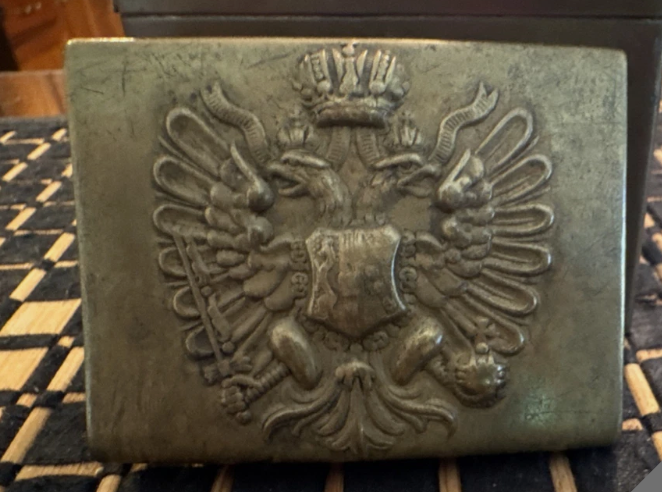
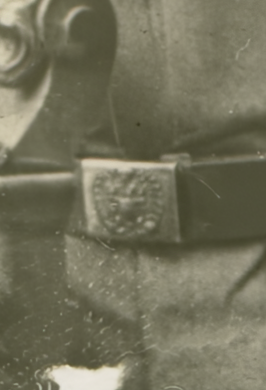
Wide leather belt with a prominent buckle. Puttees and boots.
Setting: A typical photographer’s studio backdrop with a soft, mottled/draped effect. They stand on a patterned rug. The overall composition is formal and symmetrical, common for military keepsake portraits of the period.
The uniforms are field-service style (not full dress), with practical elements like puttees and equipment, suggesting the photo was taken during or just before active service rather than in peacetime garrison.
Historical context:
This is a k.u.k. (kaiserlich und königlich / Imperial and Royal) Austro-Hungarian Army portrait from World War I. The high collars with star rank insignia on colored or plain Paroli patches, the cut of the tunic with bellowed/pleated pockets, the belt/holster/saber combination, and puttees are all characteristic of Austro-Hungarian field uniforms worn by officers, NCOs, or senior enlisted men (especially after the 1915 standardization).
The Austro-Hungarian Empire (which included territories like Bukovina in present-day Romania/Ukraine) mobilized a multi-ethnic army of millions. Soldiers from diverse backgrounds—Ukrainian, Romanian, German, etc.—served together. Formal studio photos like this were extremely common: families wanted mementos to send to loved ones or keep as soldiers deployed to the Eastern or Italian fronts. Many such portraits were taken in 1915–1918 before troops left for the front.
The surname “Tudin” in the filename, combined with the family’s later presence in Toronto/Ottawa (Bukovynian Greek Orthodox community), strongly suggests these men (or their immediate family) originated from the Bukovina region of the Austro-Hungarian Empire. After the empire’s collapse in 1918 and the upheavals of war and border changes, many residents of Bukovina emigrated to Canada. A John Tudin (born 1887, died 1951) buried in Ottawa’s Bukovynian cemetery fits the timeline perfectly for someone of service age during WWI.
In short, this is a poignant family heirloom capturing two young men in the uniform of the Austro-Hungarian Army at a moment when Europe was engulfed in total war—very likely sent home as a farewell or keepsake before they went into battle.