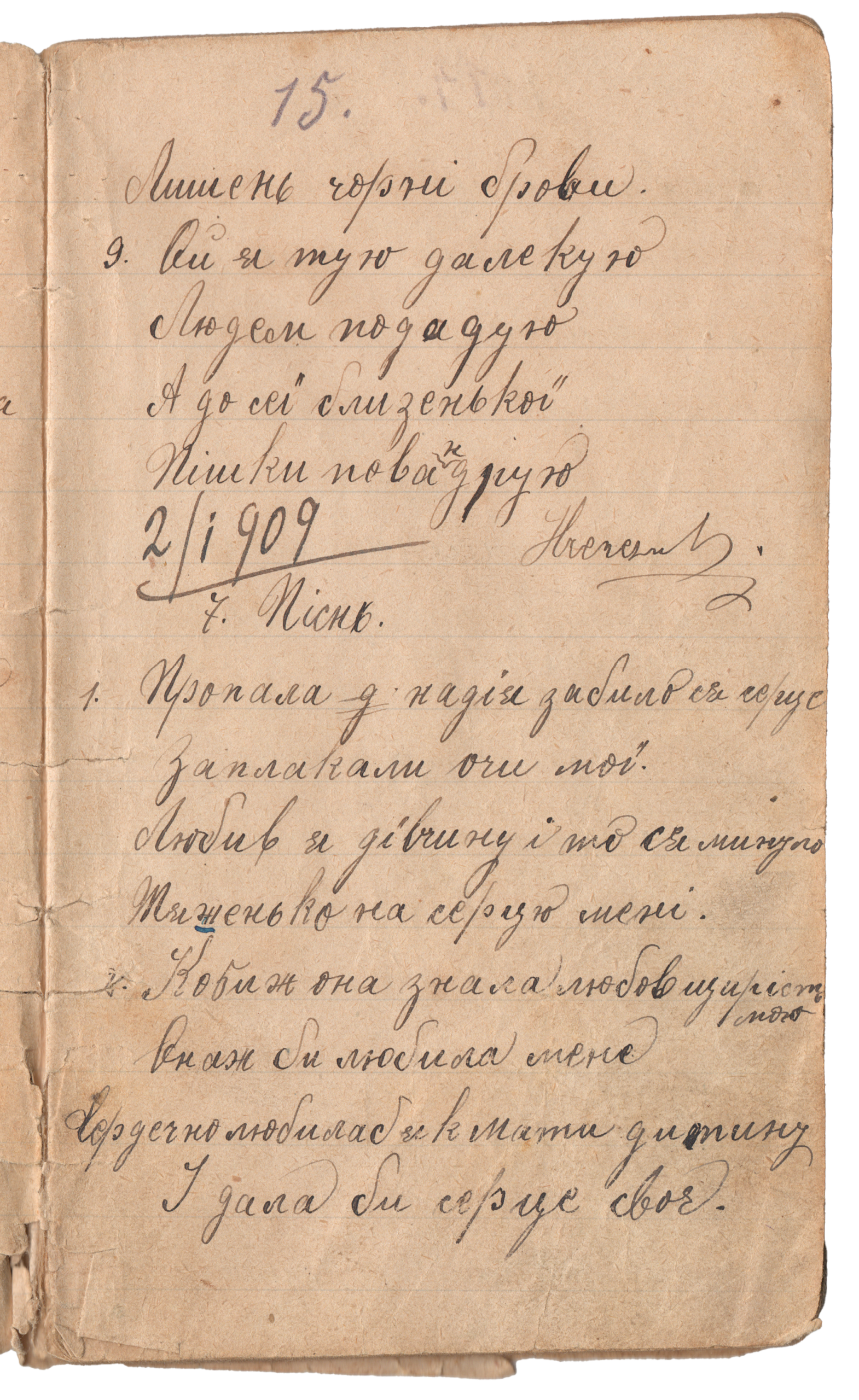
15.
Лишені горні брови.
9. Ві я туну далеку
Людем подару
А до сеї” близенької
Нішки повідру
2/i 909 Нкемць.
7. Піснь.
1. Пропала д. надія забилось серце
Заплакали очи мої.
Любив я дівчину і то ся минуло
Маленько на серцю мені.
2. Коб я она знала любов щирість
Внаж си любила мене
Сердечно любила ся к мати дитину
І дала би серце своє.
15.
Only the black eyebrows.
9. I will give that distant one
To the people as a gift
And to this close one
I will dedicate my steps.
2/1 909 Negents.
7. Song.
1. Hope has perished, the heart is pounding
My eyes have cried.
I loved a girl and that has passed
It is a little heavy on my heart.
2. If only she knew love and sincerity
She truly loved me
She loved with all her heart like a mother loves a child
And she would give her heart.
The poem/song (titled “7. Pisn’.” on page 15 of the notebook) is a short, intimate Ukrainian folk lyric from January 1909.
Core meaning At its heart, the speaker is quietly grieving a love that has ended. Hope has “perished,” his heart feels numb or “forgotten itself,” and his eyes have cried. The romance with the girl (“divchyna”) now belongs to the past — it “has passed” and only leaves a small, lingering sting (“myshen’ko na serciu meni”). Yet in the second stanza he tenderly remembers how deeply she loved him: her love was sincere (“shchirist’”), whole-hearted, and almost maternal (“serdechno liubyla sia k maty dytinu”). She gave him her heart completely. The poem therefore holds two emotions at once — sorrow for the loss and grateful wonder at the purity of the affection he once received.
Main theme The bittersweet passage of time in romantic love: the pain of separation or fading passion, contrasted with the enduring memory of sincere, selfless devotion. It is a classic lament of lost (or unrequited) love that still cherishes the beauty of what was.
Cultural content This piece belongs to the centuries-old tradition of Ukrainian lyrical folk songs (pisni). Such songs were (and still are) central to Ukrainian village culture — performed at weddings, evenings around the fire, or simply while working. Common motifs you see here appear in thousands of other Ukrainian folk texts:
The notebook itself (dated 1909 and signed “Hnesnyk”) is a typical example of how educated or literate Ukrainians at the turn of the 20th century collected and preserved oral folk poetry. Ukraine was then part of the Austro-Hungarian and Russian empires; folk songs were one of the main ways national identity and emotional life were kept alive in the face of political pressure. The language is folk Ukrainian (with some dialectal spelling and old orthography), exactly the kind of everyday speech people sang in rural Galicia or Bukovina around 1909.
In short, it is a small, personal window into the universal yet deeply Ukrainian experience of love remembered with both heartache and reverence — the kind of song that would have been sung quietly, perhaps while walking home or sitting alone at night.