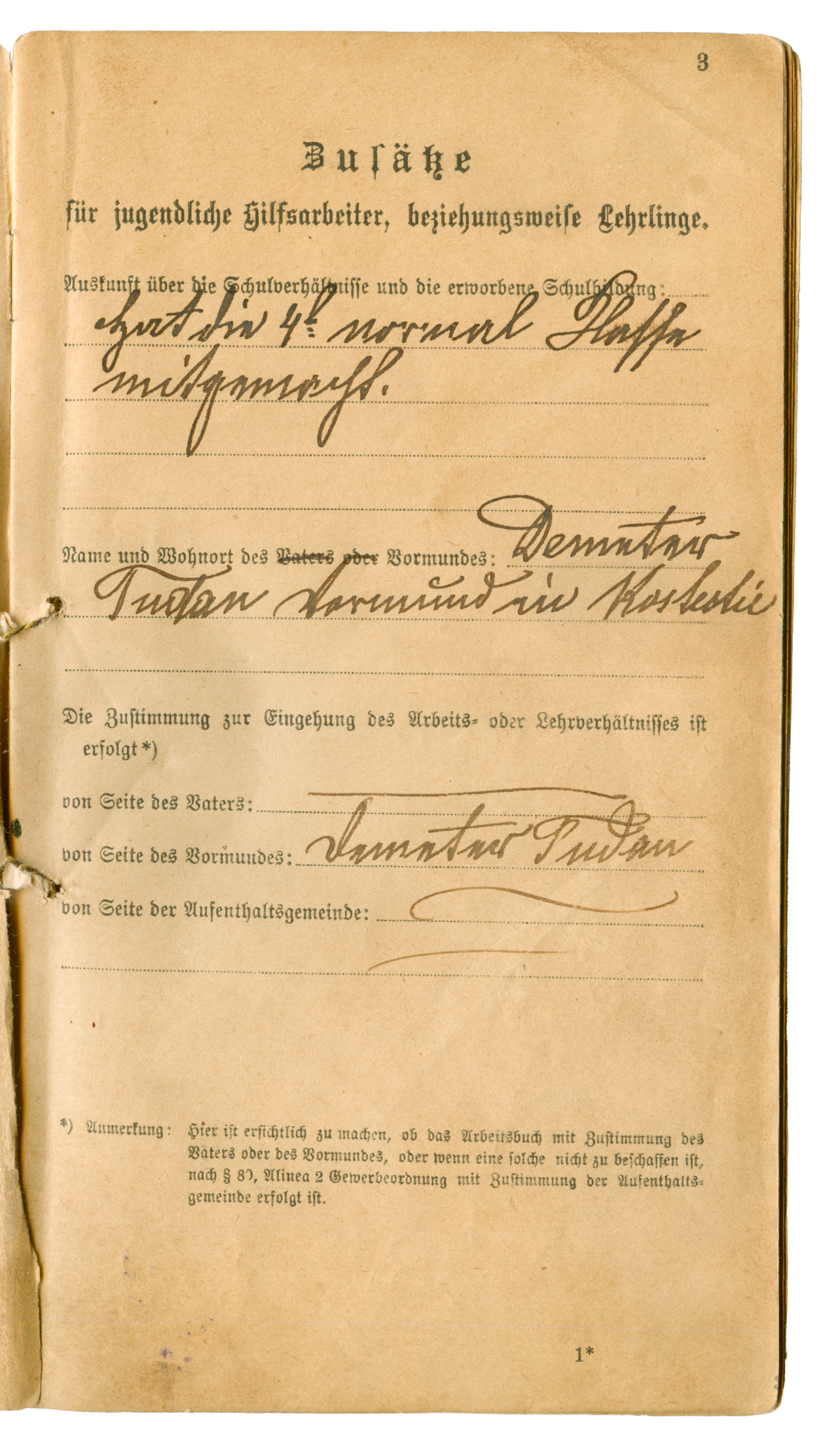
Zusätze
für jugendliche Hilfsarbeiter, beziehungsweise Lehrlinge.
Auskunft über die Schulverhältnisse und die erworbene Schulbildung:
hat die 4. normal Klasse mitgemacht.
Name und Wohnort des Vaters oder Vormundes:
Demetrius Tudam Koselkie
Die Zustimmung zur Eingehung des Arbeits- oder Lehrverhältnisses ist erfolgt*)
von Seite des Vaters: Demetrius Tudan
von Seite des Vormundes: Demetrius Tudan
von Seite der Aufenthaltsgemeinde:
*) Anmerkung: Hier ist ersichtlich zu machen, ob das Arbeitsbuch mit Zustimmung des Vaters oder des Vormundes, oder wenn eine solche nicht zu beschaffen ist, nach § 89, Absatz 2 Gewerbeordnung mit Zustimmung der Aufenthaltsgemeinde erfolgt ist.
1*
Additions
for juvenile auxiliary workers, or respectively apprentices.
Information on the school circumstances and the acquired schooling:
has attended the 4th normal class.
Name and place of residence of the father or guardian:
Demetrius Tudam Koselkie
The consent to enter into the employment or apprenticeship relationship has been granted*)
from the side of the father: Demetrius Tudan
from the side of the guardian: Demetrius Tudan
from the side of the municipality of residence:
*) Note: It must be made evident here whether the work book was issued with the consent of the father or the guardian, or if such cannot be obtained, pursuant to § 89, paragraph 2 of the Trade Regulations with the consent of the municipality of residence.
1*
§ 89 of the Gewerbeordnung (German/Austrian Industrial Code / Trade Regulations) – Explanation in context
In the early 20th century (the period of your Arbeitsbuch, around 1909–1910), § 89 of the Gewerbeordnung regulated the legal requirements for minors (youthful auxiliary workers or apprentices) entering into an employment or apprenticeship contract.
The note on page 3 explicitly refers to § 89, Absatz 2 (Paragraph 2). It states that the Arbeitsbuch (work booklet) could be issued:
This was the exact situation covered by § 89 Abs. 2. It served as a legal safeguard to allow young people to legally start work or apprenticeships even without parental approval, by substituting official municipal approval.
This provision was part of the broader 1869/1883/1900s versions of the Gewerbeordnung that applied across the German Empire and the Austrian half of the Austro-Hungarian Empire (where your workbook appears to originate, given the village name Koselkie and the German-language form).
In short: § 89 Abs. 2 was the “backup consent” clause that let the township/municipality sign off on the work booklet when the father or guardian could not or would not. That’s exactly why Demetrius Tudan (or the local authority) is listed in your workbook.