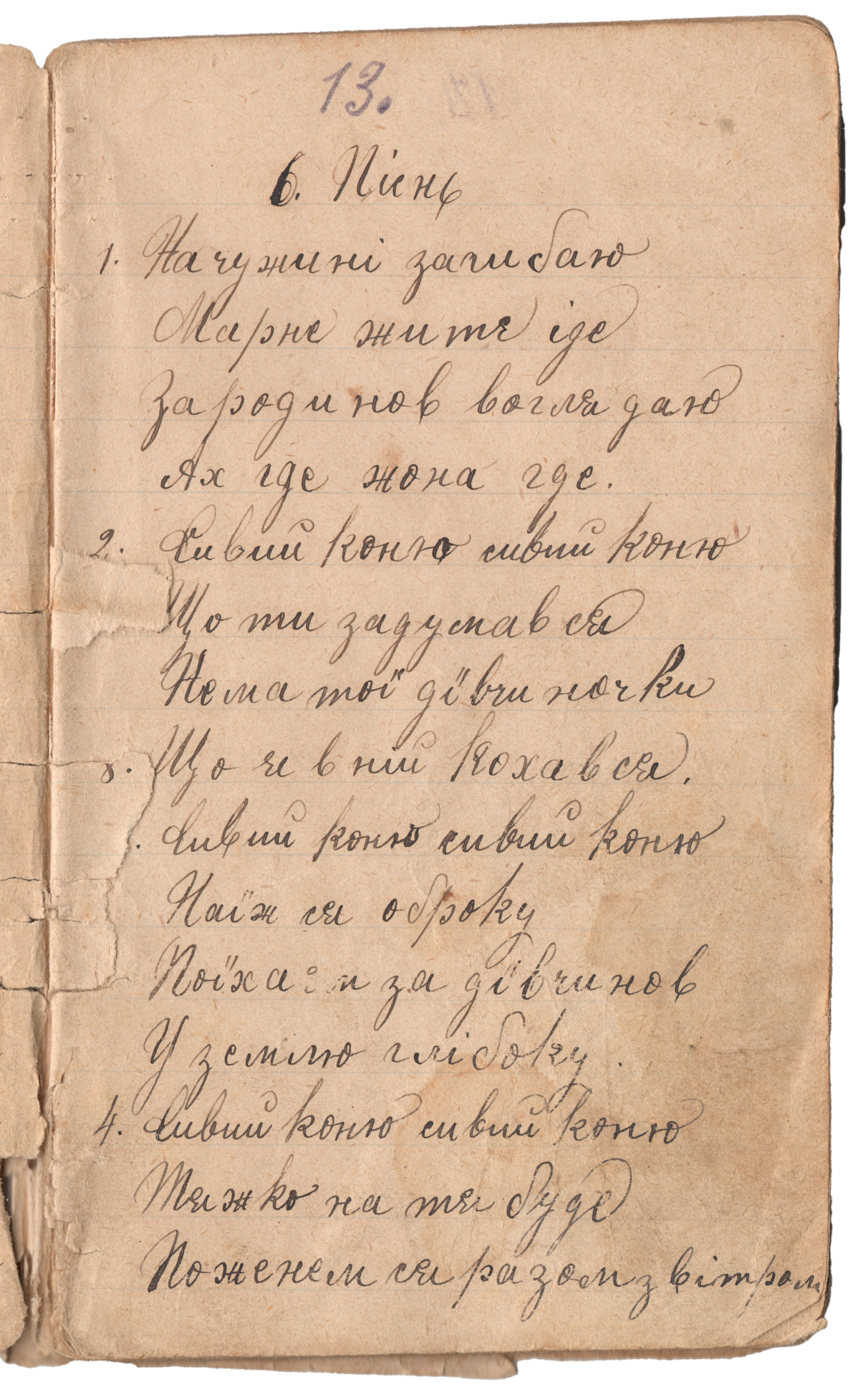
13.
6. Піснь
1. На чужині замисано
Марне житє іде
Зароди нов богля дано
Ах іде жона где.
2. Сивий коню сивий коню
Що ти задумав ся
Нема тої дівиноньки
Що я в ній кохав ся.
Сивий коню сивий коню
Найж ся оброки
Поїхав я за дівиною
У землю глібоку.
4. Сивий коню сивий коню
Милко на тии буде
Поженем ся разом з вітром
13.
6. Song
1. It is written in a foreign land
Wretched life goes by
For the new I give thanks to God
Ah, where is the wife, where.
2. Gray horse, gray horse
What have you decided
There is no that little girl
That I loved in her.
Gray horse, gray horse
Graze on the oats
I rode after the girl
Into the deep earth.
4. Gray horse, gray horse
It will be hard on you
We will gallop together with the wind
Core Message The text on pages 10 and 13 forms a deeply personal, heartfelt lament about love as the sole reason for living. The speaker’s entire existence—his happiness, purpose, and even survival—hinges on the affection of his beloved (“Мила” / dear Mila). Without her love he is lost, ruined, or already half-dead. The verses blend tender devotion with raw desperation: her face alone can “end my life,” yet only her love can make him truly happy. The song on page 13 intensifies this into a journey of grief—he is in a “foreign land” (чужині), life feels worthless, and he rides a gray horse in search of the girl who has vanished “into the deep earth” (у землю глібоку), a clear folk-poetic reference to the grave or irreversible loss.
Central Theme Romantic longing and the pain of separation — classic Ukrainian folk-song territory. Love here is not light or playful; it is existential. The beloved is both life-giving and life-destroying. The gray horse, the endless road, the foreign land, and the “deep earth” are traditional folk symbols of exile, death, or emigration—common motifs in early-20th-century Ukrainian songs (especially around 1909, the date noted elsewhere in the notebook). The speaker is simultaneously faithful and heartbroken, addressing the horse as a silent companion while mourning a love that feels permanently out of reach.
In short, these two pages capture the emotional core of the whole notebook: love as the only thing that gives life meaning, and the crushing sorrow when that love is taken away by distance, time, or death. Pure folk-romantic melancholy.
The speaker is “на чужині” (in a foreign land), cut off from home, life, and love. In Ukrainian folk tradition, especially Cossack and steppe songs, the horse is the Cossack’s truest friend — more reliable than people, sharing every hardship. Here the speaker turns to it with intimate questions (“Шо ти задумав ся?” — “What have you decided?”) as if the horse can understand and even decide his fate. It has replaced the lost “divinonky” (little maiden) and “жона” (wife). The horse becomes the speaker’s only remaining “self” — an extension of his soul in a world where human bonds have been severed.
This is the richest layer. The speaker instructs the horse to graze for a year (“Наїж ся о року”), then “Поїхай за дівчиною / У землю глибоку” (Ride after the maiden into the deep earth). “Глибока земля” is classic folk euphemism for the grave. The horse is being asked to act as a psychopomp — a mediator that carries the living to the dead or escorts the soul across the boundary between worlds. In Ukrainian laments and ballads, the horse frequently performs this role: it “digs the grave with its hooves,” weeps for its master, or carries him to his beloved in the otherworld. By sending the horse after the maiden, the speaker is essentially planning his own death-journey so he can be reunited with her.
The closing image — “Поженися разом з вітром” (You will race together with the wind) — elevates the horse to a cosmic force. The wind in Ukrainian folklore is restless, untamed, and often linked to the soul’s flight after death. Merging with the wind symbolizes:
The gray horse is no longer just transportation — it becomes the embodiment of liberation through death. The “hard road” (“Тяжко на тій суді”) acknowledges the pain of that final journey, yet the speaker embraces it.
The adjective “сивий” is deliberate. In folk poetry it carries layered connotations:
It echoes the “pale horse” archetype found across Indo-European traditions, but here it is distinctly Ukrainian: a faithful, melancholy companion that bridges the living and the dead.
This motif recurs throughout Ukrainian folk “pisni” (lyrical songs) and “dumy” (epic laments). Horses appear in joyful courtship songs, but in tragic laments like this one they almost always signal irreversible loss, exile, or mortality. Looking at the other pages you’ve shared from the same notebook, the recurring themes of separation, premature death, and longing for “Мила” (dear one) make the horse here a perfect symbolic pivot: it is the only thing still capable of action when the speaker himself is paralyzed by grief.
In short, the gray horse is simultaneously:
It transforms a personal cry of mourning into a universal folk archetype of love stronger than death. The poem is spare, but the horse carries an enormous emotional and mythological weight — exactly why this four-stanza piece feels so haunting.