48,
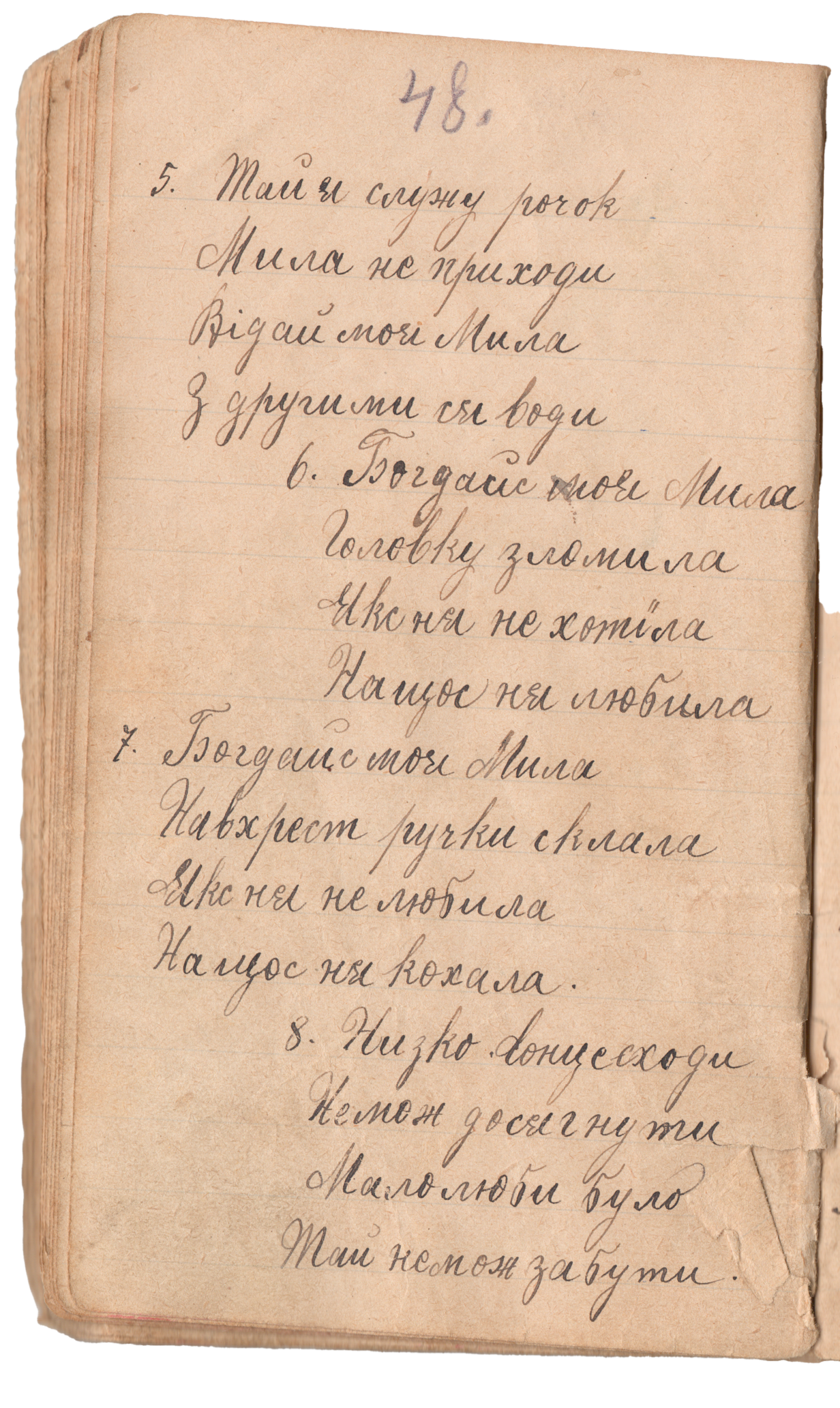
5. Май и слуну рогок
Мила не приходи
Віддай мої Мила
З другими ся води
6. Богдайс моєї Мила
Головку зломила
Як с ня не хотіла
Нацос ня любила
7. Богдайс моєї Мила
Навхрест руки склала
Як с ня не любила
Нацос ня кохала.
8. Низко.донцесходи
Немож досегнути
Малолюби було
Май немож забути.
48,
5. May I blow the horn
Mila do not come
Give back my Mila
With others you play
6. God grant my Mila
She broke her head
As if she didn’t want me
For that she loved me
7. God grant my Mila
She folded her hands crosswise
As if she didn’t love me
For that she loved me.
8. Low the sunset descends
It is impossible to reach
It was little loved
I cannot forget.
The core of page 48 is a raw, bitter lament from a heartbroken speaker directly confronting his beloved “Mila.” He tells her not to come to him anymore, demands she return what she “took” (his heart/love), and unleashes a series of ironic “curses” (the repeated folk expression “Богдайс” — “God grant” or “may it be”) wishing her physical or emotional suffering because she only pretended to love him while actually rejecting him and turning to others. The final lines shift to a quiet, aching metaphor: the low sunset that can never be reached symbolizes the unreachable, fleeting nature of their love and the speaker’s helpless inability to forget her.
The overarching theme is the torment of betrayed or unrequited love — the toxic mix of resentment, jealousy, sarcasm, and lingering attachment that refuses to let go even when the relationship is clearly over. It captures that classic folk-song emotional spiral: anger at the betrayal mixed with the painful realization that the heart still clings to the memory.
The indented “paragraphs” (really indented lines or blocks of text) you’re noticing across some pages are deliberate formatting choices made by Gofina Hrepenyk herself while copying the songs.
Here’s why it happens on certain pages but not others:
It’s a very common practice in early-20th-century handwritten Ukrainian pisni notebooks like this one. The indentation isn’t random — it’s Gofina’s way of organizing the material so the songs are easier to perform or remember. It turns a simple notebook into something that feels more like a real song collection.