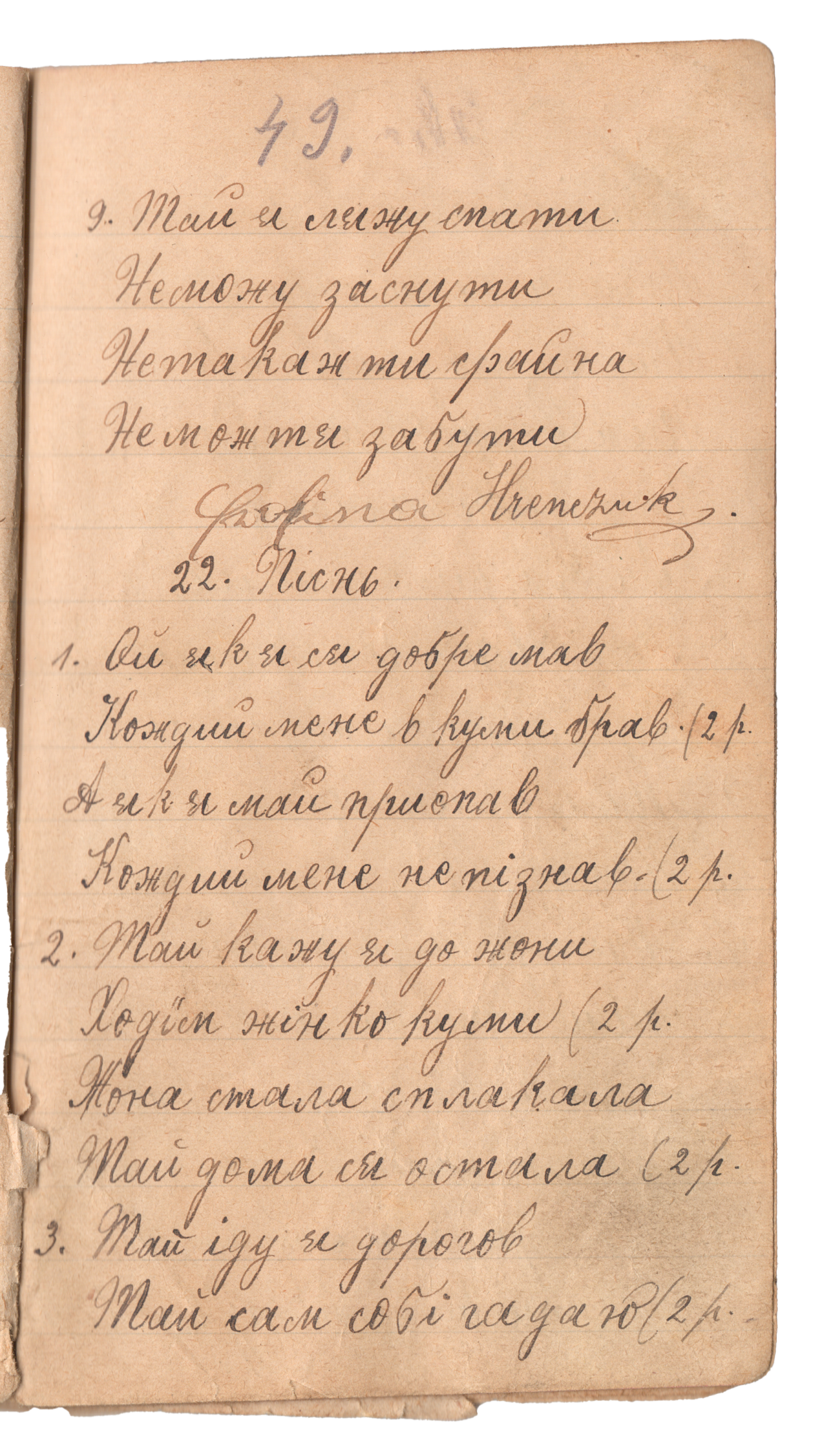
49.
9. Май и слiжу спати
Неможну заснути
Нетакан ти срабина
Немож ти забути
Гофiна Нreпeнiкъ.
22. Пiснь.
1. Ой як я ся добре мав
Кождий мене в куми брав.(2р.)
А як я май припова
Кождий мене не пізнав.(2р.)
2. Май кажу я до жони
Ходiв нiжко куми (2р.)
Жона стала сплакала
Май дома ся остала (2р.)
3. Май iду я дорогой
Май сам собi гадаю(2р.)
49.
9. I want to lie down to sleep
I cannot fall asleep
It’s not like that, you scoundrel
I cannot forget you
Gofina Nrepenik.
22. Song.
1. Oh how well I had it
Everyone invited me to be godfather.(2x.)
But when I had the christening
Everyone did not recognize me.(2x.)
2. I say to my wife
I went to a few godmothers (2x.)
The wife started crying
I stayed at home (2x.)
3. I go on the road
I think to myself(2x.)
“Гофiна” (Gofina) was written right beside (actually immediately before) the recurring signature “Нрепенiкъ.” (Hrepenyk) for one very straightforward reason: it is the first/given name of the same person whose family name is Hrepenyk.
In hundreds of similar early-20th-century Ukrainian handwritten folk-song notebooks (especially from Galicia/Bukovyna, where many are dated around 1909), the owner or main scribe would sign with the surname alone — a common rural practice. Later, when reviewing, organizing, or claiming the collection (or when passing the notebook to family), they (or a relative) added the first name in front of it to make the ownership completely clear. That’s exactly what happened here: different ink, slightly higher and more cramped positioning, added after the rest of the page was already written.
So on page 49 you’re looking at the full name of the compiler/owner: Gofina Hrepenyk. The signature “Нрепенiкъ.” appears at the end of many songs throughout the book; “Гофiна” was the later personal touch that identifies who that Hrepenyk actually was. It’s the handwritten equivalent of writing “This book belongs to Gofina Hrepenyk.”
Core content
Overall theme of the page It juxtaposes deep romantic torment (insomnia, betrayal, inability to forget) with village social satire (changed status after marriage/parenthood, gossip, domestic tension). This pairing is typical of handwritten pisni collections: the scribe (Gofina) uses the notebook both to preserve communal folk songs and to express private emotional truths. The prominent full-name signature makes the page feel especially personal — almost as if Gofina is saying “this lament is mine too.”