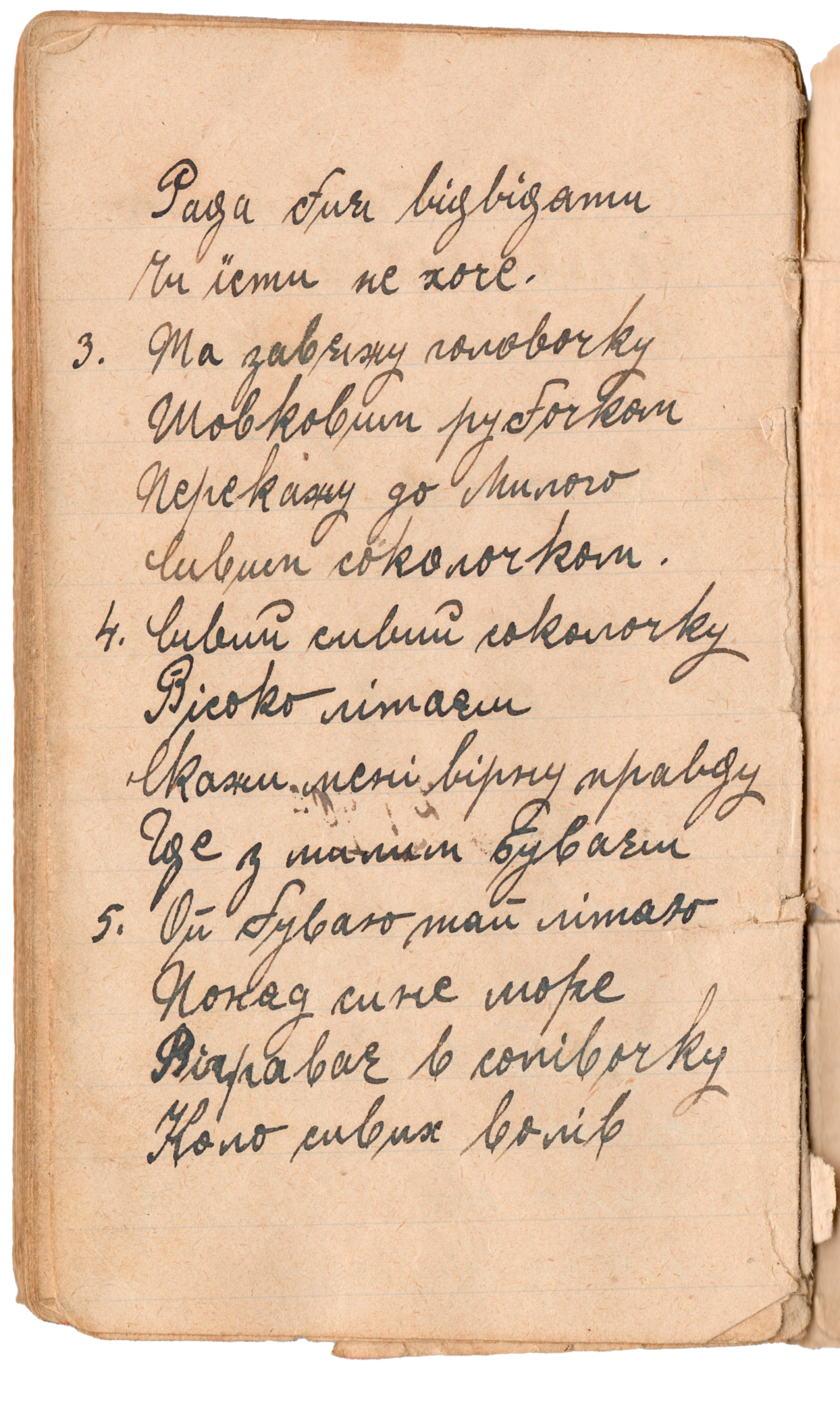
Рада би я відзнати
Чи їсти не хоче.
3. Ма забавну половорку
Мовковим рудокопом
Перекажу до милого
Сивим соколиком .
4. Сивий сивий соколику
Високо-літаєш
Скажи мені вірну правду
Що з мамим буває
5. Ой буваю май літаю
Понад синє море
Випадаю в сонворку
Коло сивих воїв
I would be glad to find out
Whether he doesn’t want to eat.
3. I have a funny little saying
Like a ruddy miner
I will convey it to my dear one
With a gray falcon.
4. Gray gray falcon
You fly high
Tell me the true truth
What happens with my mother
5. Oh I fly I fly
Over the blue sea
It flies out into the sunflower field
Near the gray oxen
The speaker is playfully yet anxiously trying to find out how her “милий” (dear one / beloved) is doing — specifically whether he even wants to eat or is well. She can’t ask directly, so she wraps her concern in a “funny little saying” and sends it like a secret message via trusted folk symbols: a gray falcon (the classic Ukrainian messenger of the heart) and a “ruddy miner” (a humble, earthy figure who can carry news). The falcon is asked to fly high, look down, and bring back the “true truth” about what’s happening with her loved one. The final lines shift to the speaker herself soaring “over the blue sea” and landing in a sunflower field near gray oxen — a vivid, almost dream-like image of restless longing and emotional wandering.
Central theme:
Anxious, tender longing across distance. This is classic Ukrainian folk-song territory: separation, worry for a beloved who is far away (perhaps a Cossack, soldier, or migrant worker), and the use of nature and birds as intermediaries. The speaker feels powerless to reach him directly, so she turns to poetic code — the falcon, the sea, the sunflower field — to express care without seeming too forward. It’s both playful (the “funny saying”) and deeply heartfelt, blending humor, folk imagery, and quiet heartache. The sunflower field and gray oxen ground it in rural, everyday Ukrainian life, while the soaring falcon lifts it into the realm of romantic folklore.
This stanza fits perfectly into the larger notebook you’ve been sharing: a personal collection of love songs full of parting, fidelity, and emotional yearning, all transcribed around 1909 in a distinct western-Ukrainian folk style. The motif of sending a bird or message to check on a distant lover appears repeatedly across the pages.