80
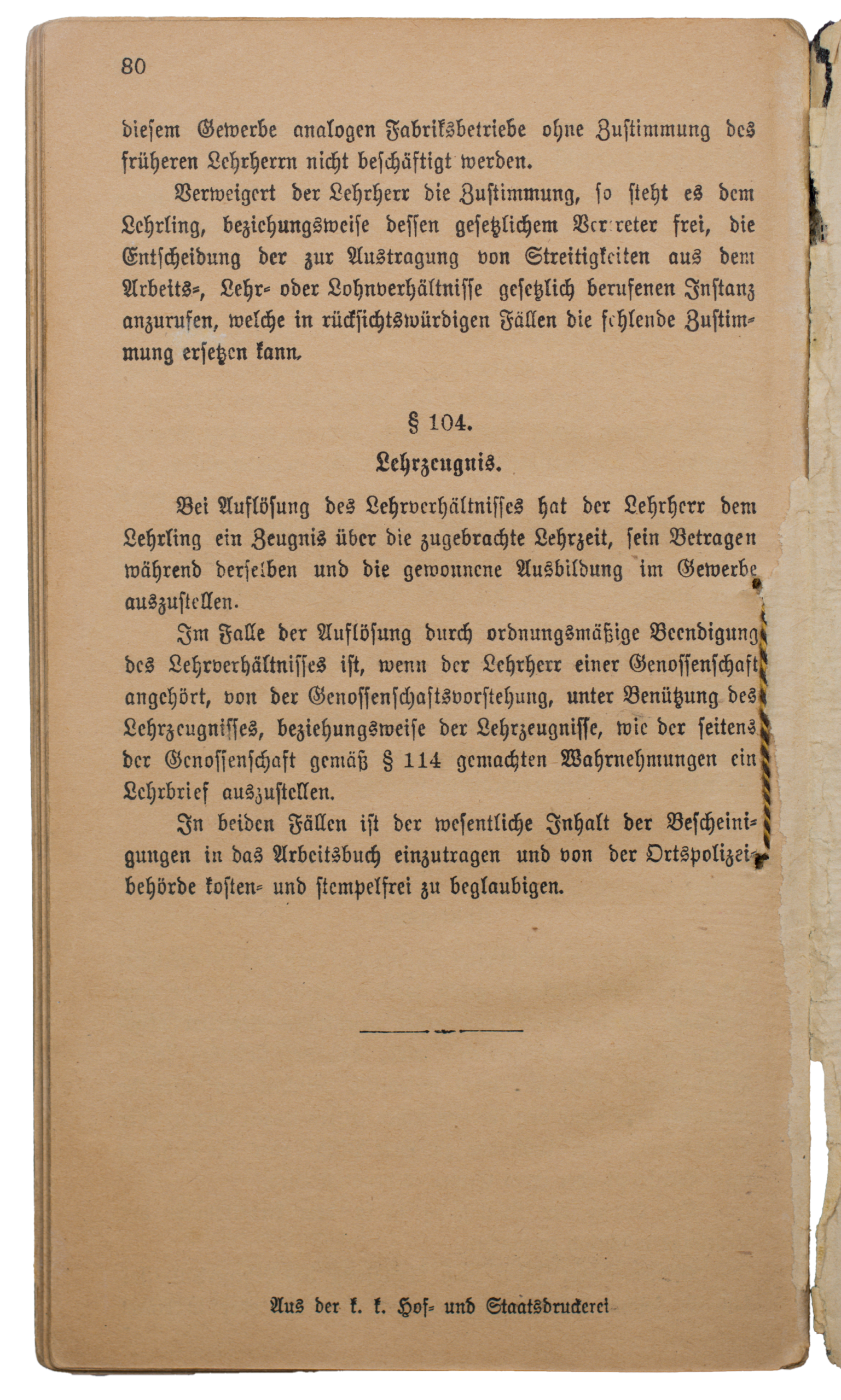
diesem Gewerbe analogen Fabriksbetriebe ohne Zustimmung des
früheren Lehrherrn nicht beschäftigt werden.
Verweigert der Lehrherr die Zustimmung, so steht es dem
Lehrling, beziehungsweise dessen gesetzlichem Ver-
treter frei, die Entscheidung der zur Austragung von Streitigkeiten aus dem
Arbeits-, Lehr- oder Lohnverhältnisse gesetzlich berufenen Instanz
anzurufen, welche in rücksichtswürdigen Fällen die fehlende Zustim-
mung ersezen kann.
§ 104.
Lehrzeugnis.
Bei Auflösung des Lehrverhältnisses hat der Lehrherr dem
Lehrling ein Zeugnis über die zugebrachte Lehrzeit, sein Betragen
während derselben und die gewonnene Ausbildung im Gewerbe
auszustellen.
Im Falle der Auflösung durch ordnungsmäßige Beendigung
des Lehrverhältnisses ist, wenn der Lehrherr einer Genossenschaft
angehört, von der Genossenschaftsvorstehung, unter Benützung des
Lehrzeugnisses, beziehungsweise der Lehrzeugnisse, wie der seitens
der Genossenschaft gemäß § 114 gemachten Wahrnehmungen ein
Lehrbrief auszustellen.
In beiden Fällen ist der wesentliche Inhalt der Bescheini-
gungen in das Arbeitsbuch einzutragen und von der Ortspolizei-
behörde kosten- und stempelfrei zu beglaubigen.
────────────────────
Aus der k. k. Hof- und Staatsdruckerei.
80
this trade or analogous factory operations without the consent of the
former master not be employed.
If the master refuses his consent, the apprentice or, respectively, his
legal representative is free to appeal the decision to the legally
appointed authority for settling disputes arising from the employment,
apprenticeship or wage relationship, which in deserving cases can
supply the missing consent.
§ 104.
Apprenticeship Certificate.
Upon dissolution of the apprenticeship relationship the master shall
issue to the apprentice a certificate concerning the apprenticeship
time completed, his conduct during the same, and the training
acquired in the trade.
In the case of dissolution by regular termination of the
apprenticeship relationship, if the master belongs to a guild, the
guild executive shall issue, using the apprenticeship certificate or
respectively the apprenticeship certificates as well as the observations
made by the guild pursuant to § 114, an apprenticeship diploma.
In both cases the essential content of the certificates shall be
entered into the work book and authenticated free of cost and
stamp duty by the local police authority.
────────────────────
From the Imperial and Royal Court and State Printing Office.
The sections on pages 79–80 (especially §104 on the Lehrzeugnis / apprenticeship certificate and the earlier references to Genossenschaft) directly reflect the late-19th/early-20th-century role that guilds still played in regulating apprenticeships under the Austrian Trade Regulations (Gewerbeordnung). Here’s a concise overview tied to what we’ve seen in the legal text:
Craft guilds emerged across Europe in the 11th–13th centuries as urban associations of master artisans. In German-speaking lands (including the territories that became the Austro-Hungarian Empire), they were powerful self-governing bodies that:
This system protected both masters and workers but also restricted mobility and innovation—exactly the kind of traditional controls the 19th-century Gewerbeordnung was trying to modernize while preserving the valuable apprenticeship certification parts.
Under Maria Theresa and Joseph II (mid-to-late 1700s), the Habsburg state began centralizing control and chipping away at guild monopolies to promote economic growth. The big turning point came with the Gewerbeordnung of 1859 (the foundational Austrian industrial code, with later amendments reflected in the edition we’re translating). It introduced Gewerbefreiheit (freedom of trade), which:
However, the law deliberately kept guilds (now often reorganized as voluntary Genossenschaften or Innungen) alive for apprenticeship oversight. This is precisely what §104 codifies: if the master belongs to a guild, the Genossenschaftsvorstehung (guild executive) issues the official Lehrbrief (apprenticeship diploma) using the master’s Lehrzeugnis plus the guild’s own observations (§114). The state (via Ortspolizeibehörde / local police authority) then provides free, stamp-free authentication and entry into the Arbeitsbuch. This hybrid system balanced liberal free enterprise with the need for structured vocational training and quality control.
By the time Johann Tudan’s Arbeitsbuch was in use (around 1909–1910, as seen in the handwritten pages), this regulated guild role was still very much alive. The Arbeitsbuch itself served as the official portable record that replaced some of the older guild-controlled documentation. It tracked entry/exit dates, conduct, and certificates—exactly the “essential content” that §104 requires to be entered and authenticated. Guilds no longer had absolute power, but they remained key gatekeepers for formal recognition of skilled training, especially in traditional crafts.
This Austrian model influenced the strong dual vocational education system still found in modern Germany and Austria today—apprenticeships combine workplace training with theoretical instruction, and chambers of commerce/guild-like bodies still issue certifications.
In short, the pages we’ve translated show guilds in their “twilight” phase: stripped of medieval monopolies by 19th-century liberalism, yet retained as useful institutions for apprenticeship standards and record-keeping under state supervision. It’s a fascinating bridge between medieval craft traditions and the industrial-era labor laws that shaped early 20th-century workers like Tudan.